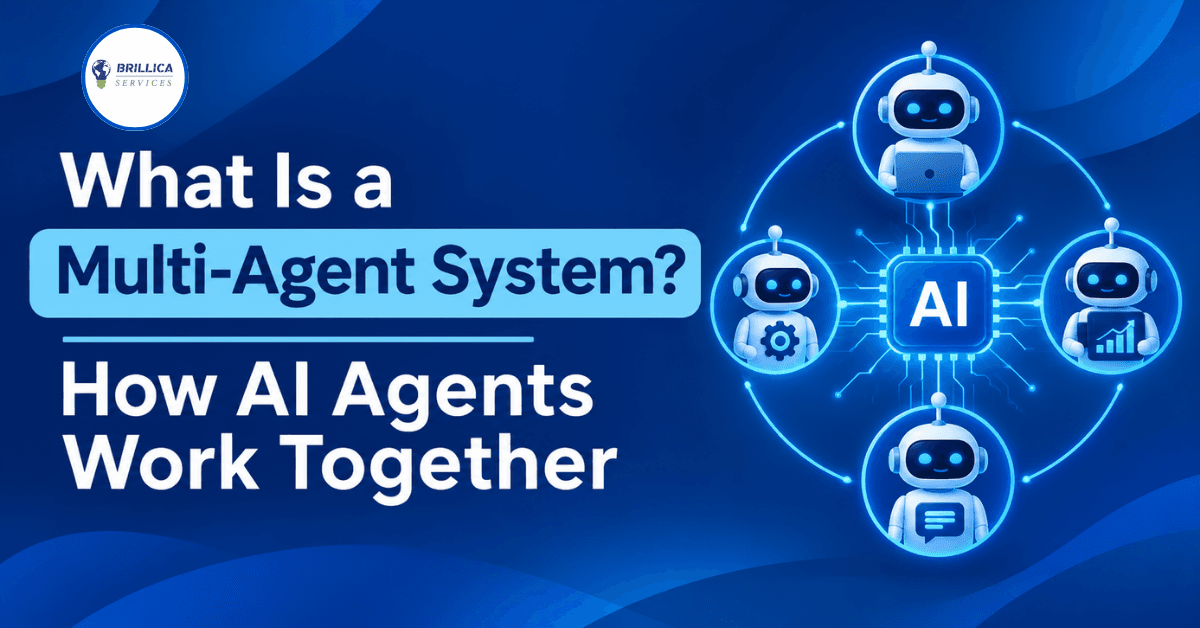
One AI agent can answer questions, write code or search the web. But what happens when a task is too big for one agent, like researching a market, writing a report, checking the numbers and preparing a presentation? That is where a multi-agent system comes in. Instead of one AI doing everything, a team of specialised AI agents divides the work, talks to each other and delivers the result together.
In this guide, you will learn what a multi-agent system is, how AI agents work together, the main architectures, popular frameworks, real-world use cases and the skills you need to build one.
What Is a Multi-Agent System?
A multi-agent system (MAS) is a setup in which two or more AI agents work together to complete a goal. Each agent has its own role, instructions and tools, and the agents share information, hand over tasks and check each other's work.
Think of it like a project team in an office. A manager breaks the project into tasks, a researcher collects information, a writer drafts the content and a reviewer checks quality. A multi-agent system copies this teamwork using AI agents, usually powered by large language models (LLMs) such as GPT, Claude or Gemini.
If you are new to the idea of agents, start with our guide on what AI agents are and how they work.
Single Agent vs Multi-Agent System
Feature | Single AI Agent | Multi-Agent System |
|---|---|---|
Structure | One agent handles the whole task | Several agents, each with a specific role |
Best for | Simple, focused tasks | Complex, multi-step tasks |
Accuracy | Can lose focus on long tasks | Agents can review and correct each other |
Speed | Works step by step | Agents can work in parallel |
Cost and complexity | Lower | Higher; needs planning and monitoring |
Example | A chatbot answering FAQs | An AI team that researches, writes and fact-checks a report |
How Do AI Agents Work Together?
Every multi-agent system, simple or advanced, is built on a few core ideas.
1. Roles and Specialisation
Each agent gets a clear job, for example "Research Agent", "Data Analyst Agent" or "Quality Checker Agent". A narrow role with focused instructions usually gives better results than one agent trying to do everything.
2. Communication
Agents pass messages to each other, such as task instructions, results, questions or feedback. Communication can happen through a shared conversation, a message queue or a shared memory (often called a "blackboard") where every agent can read and write.
3. Task Delegation and Planning
A planner or manager agent breaks a big goal into smaller tasks and assigns them to the right agents. When an agent finishes, it hands the output to the next agent in the workflow.
4. Tool Use
Agents become powerful when they can use tools: web search, databases, Python code execution, APIs, spreadsheets or email. Standards such as the Model Context Protocol (MCP) make it easier to connect agents to tools and data sources.
5. Memory and Shared Context
Agents need to remember what has already been done. Short-term memory keeps track of the current task, while long-term memory (often a vector database) stores knowledge the agents can reuse later.
6. Review and Feedback Loops
One of the biggest advantages of a multi-agent system is self-correction. A reviewer agent can check another agent's output, point out mistakes and send it back for improvement before the final answer is delivered.
A Simple Example: Multi-Agent System for a Sales Report
Imagine a company asks an AI system: "Prepare a monthly sales report with insights and recommendations." Here is how a multi-agent team might handle it:
Manager Agent reads the request and creates a plan: collect data, analyse it, write the report, review it.
Data Agent connects to the sales database and pulls last month's figures using SQL.
Analyst Agent uses Python to find trends, top products and regions with falling sales.
Writer Agent turns the analysis into a clear report with charts and recommendations.
Reviewer Agent checks the numbers against the source data and flags any errors.
Manager Agent approves the final report and shares it with the team.
This is exactly why data analytics and agentic AI skills are now being learned together. Data professionals who can build such workflows save hours of manual reporting every week.
Types of Multi-Agent Architectures
There is no single way to organise AI agents. These are the most common patterns:
Architecture | How It Works | Best Use Case |
|---|---|---|
Hierarchical (Manager–Worker) | A supervisor agent plans the work and delegates tasks to worker agents | Report generation, project-style workflows |
Sequential (Pipeline) | Agents work one after another; each passes output to the next | Content creation, data processing pipelines |
Parallel | Several agents work on different parts of a task at the same time, and the results are combined | Research across many sources, large document analysis |
Collaborative (Peer-to-Peer) | Agents discuss and work as equals, sharing ideas and feedback | Brainstorming, problem-solving, coding with review |
Debate / Critic | One agent proposes an answer, another challenges it, and a judge decides | Decision-making, reducing errors and hallucinations |
Popular Frameworks to Build Multi-Agent Systems
You do not have to build everything from scratch. These open-source frameworks and toolkits are widely used:
CrewAI – Lets you define a "crew" of agents with roles, goals and tasks. Beginner-friendly and popular for business workflows.
LangGraph – From the LangChain team; builds agent workflows as graphs, with fine control over steps, memory and loops.
Microsoft AutoGen – A framework for building agents that converse with each other to solve tasks, including code-writing agents.
OpenAI Agents SDK – A lightweight toolkit for building agents with tools, handoffs between agents and guardrails.
Google Agent Development Kit (ADK) – Google's framework for building and deploying multi-agent applications.
Alongside frameworks, open protocols are emerging to help agents talk to tools and to each other: MCP for connecting agents to tools and data, and Agent2Agent (A2A) for communication between agents built on different platforms.
Real-World Use Cases of Multi-Agent Systems
Customer support: One agent understands the query, another checks order details, and a third drafts the reply or escalates to a human.
Software development: Separate agents plan features, write code, write tests and review the code.
Data analytics and business intelligence: Agents fetch data, clean it, analyse it and build dashboards or summaries automatically.
Digital marketing: A research agent studies keywords and competitors, a content agent writes posts and ads, and an analytics agent tracks campaign performance.
Finance: Agents monitor transactions, flag unusual activity and prepare compliance reports.
Healthcare administration: Agents help summarise records, schedule appointments and manage paperwork, with doctors making the final decisions.
Cyber security: Agents monitor logs, detect threats and suggest responses to security teams.
Benefits of Multi-Agent Systems
Handles complex tasks: Big problems are split into manageable steps.
Better quality: Reviewer agents catch mistakes before the output reaches users.
Faster results: Agents can work in parallel.
Easy to scale and update: You can add, remove or improve one agent without rebuilding the whole system.
Specialisation: Each agent can use the model, prompt and tools best suited to its job.
Challenges and Limitations
Higher cost: More agents means more LLM calls, which increases API costs.
Coordination problems: Agents can misunderstand each other, repeat work or get stuck in loops.
Error chains: A mistake by one agent can pass to the next if there is no review step.
Debugging is harder: Tracing what went wrong across many agents needs good logging and monitoring.
Security and control: Agents that use tools need clear permissions and human approval for sensitive actions.
The rule of thumb: use a multi-agent system only when a task genuinely needs several specialised steps. For simple tasks, a single well-designed agent is often enough.
Skills You Need to Build Multi-Agent Systems
Python programming – the main language for AI and agent frameworks
LLM fundamentals and prompt engineering – writing clear roles and instructions for each agent
Agent frameworks – CrewAI, LangGraph, AutoGen and similar tools
APIs and tool integration – connecting agents to databases, search and business apps
RAG and vector databases – giving agents access to company knowledge
SQL and data handling – especially for analytics-focused agents
Testing, evaluation and monitoring – making sure agents give reliable results
For a detailed breakdown, read what skills you need to become an Agentic AI Engineer and explore Agentic AI jobs, roles and career opportunities.
Learn to Build AI Agents and Multi-Agent Systems at Brillica Services
Multi-agent systems are quickly becoming a core part of how companies use AI, and professionals who can design them are in demand. At Brillica Services, our Gen AI & Agentic AI Engineering Course covers Python, LLMs, prompt engineering, RAG and agent frameworks with hands-on projects and placement assistance.
If you want to combine agentic AI with data skills, check out our Data Analytics with Agentic AI Course and Data Science with Agentic AI Course.
Conclusion
A multi-agent system is a team of AI agents that divide work, communicate, use tools and review each other's output to complete complex tasks. From customer support to data analytics and software development, this teamwork approach is helping businesses automate work that a single AI could not handle reliably. If you are planning a career in AI, understanding how multi-agent systems work, and learning to build them, is one of the most valuable skills you can add in 2026.
Frequently Asked Questions
What is a multi-agent system in AI?
A multi-agent system is a setup where two or more AI agents, each with its own role and tools, work together, share information and review each other's work to complete a complex goal.
What is the difference between a single AI agent and a multi-agent system?
A single agent handles the whole task on its own, which suits simple tasks. A multi-agent system splits complex work among specialised agents that can work in parallel and check each other's output.
Which frameworks are used to build multi-agent systems?
Popular options include CrewAI, LangGraph, Microsoft AutoGen, the OpenAI Agents SDK and Google's Agent Development Kit (ADK).
What are some real-world examples of multi-agent systems?
Examples include customer support teams of agents, AI coding assistants that plan, write and review code, automated data analytics reporting and digital marketing workflows.
Do I need coding skills to build a multi-agent system?
Yes, basic Python is important, along with LLM and prompt engineering knowledge, API integration and familiarity with an agent framework. Some no-code tools exist, but coding gives far more control.
Where can I learn to build AI agents in Dehradun or Delhi?
Brillica Services offers a Gen AI & Agentic AI Engineering Course in Dehradun, Delhi and online, covering Python, LLMs, RAG and agent frameworks with hands-on projects and placement assistance.