


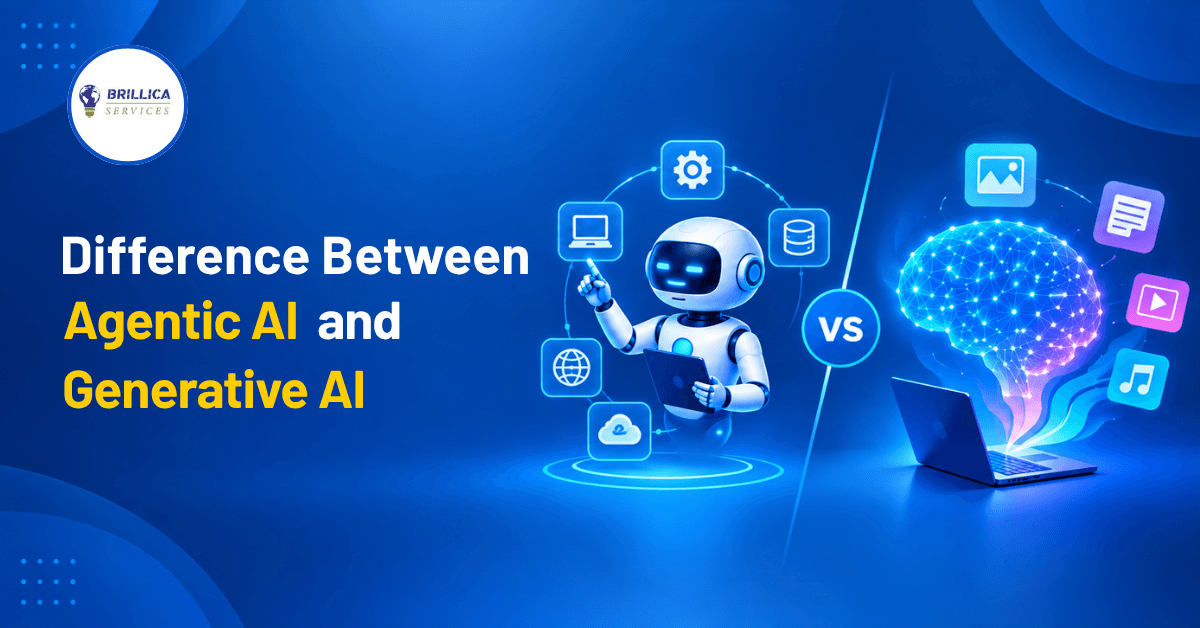
Artificial intelligence is changing quickly, and two terms you are likely to hear more often are Generative AI and Agentic AI. Although they are closely connected, they are not the same thing. Understanding the difference between agentic AI and generative AI can help students, professionals, and businesses understand what modern AI can actually do.
Generative AI is mainly designed to create new content such as text, images, code, audio, and videos. Agentic AI goes a step further by using AI models to plan tasks, make decisions, use tools, and work toward a specific goal with less human involvement. In simple terms, Generative AI can help you create, while Agentic AI can help you act and complete tasks.
In this guide, we will explain agentic AI vs generative AI, how each technology works, their differences, examples, use cases, benefits, and how businesses can use them.
What Is Generative AI?
Generative AI is a type of artificial intelligence that can create new content based on the instructions, or prompts, given by a user. It learns patterns from large amounts of training data and uses those patterns to generate responses that are relevant to the request.
For example, you can ask a Generative AI tool to write a blog introduction, create an image, summarize a document, generate Python code, or suggest marketing ideas. Instead of simply finding an existing answer, the system generates new content based on your prompt.
Popular applications of Generative AI include chatbots, AI writing assistants, image-generation tools, coding assistants, and content creation platforms. Large language models are particularly useful for generating and understanding text, while other AI models can work with images, audio, video, or multiple types of information.
What Is Generative AI Used For?
Some common generative AI use cases include:
Writing articles, emails, and social media content
Creating images and marketing visuals
Generating and explaining computer code
Summarizing lengthy documents
Creating product descriptions
Brainstorming ideas
Translating and rewriting content
Creating educational materials
Answering questions and explaining concepts
The key idea is simple: Generative AI primarily creates content in response to a request.
What Is Agentic AI?
Agentic AI refers to AI systems designed to work toward a goal by taking multiple steps, making decisions, using available tools, and adjusting their actions based on the situation.
Instead of only responding to one prompt, an AI agent can potentially break a larger objective into smaller tasks. Depending on how the system is designed, it can gather information, interact with software, call tools or APIs, evaluate results, and continue working until the task is completed or human input is needed.
For example, imagine telling an AI system: “Find suitable candidates for this job, compare their qualifications, prepare a shortlist, and create an interview schedule.” A basic Generative AI system might help you write the job description or summarize candidate profiles. An agentic system could be designed to perform several connected steps using appropriate tools and workflows.
This is one of the biggest reasons agentic AI technology is attracting attention across different industries.
What Is Agentic AI Used For?
Common agentic AI use cases can include:
Automating multi-step business workflows
Customer service automation
Research and information gathering
Software development workflows
Data analysis and reporting
IT support and troubleshooting
Sales and lead-management processes
Task scheduling and coordination
Business process automation
Personalized digital assistants
The important point is that agentic systems are generally designed around goals and actions, rather than content generation alone.
Agentic AI vs Generative AI: What Is the Difference?
The simplest way to understand the difference between agentic AI and generative AI is to look at what each system is designed to accomplish.
Generative AI primarily focuses on producing content. You provide a prompt, and the system generates an output. Agentic AI focuses more on completing a goal. It may use Generative AI as one part of a larger system, but it can also involve planning, memory, tool use, decision-making, and feedback loops.
Think about the difference between asking an AI to write a travel itinerary and asking an AI system to organize an entire trip. The first task mainly requires content generation. The second may require researching options, comparing them, checking availability through connected services, organizing information, and taking actions.
Generative AI | Agentic AI |
|---|---|
Mainly generates content | Focuses on completing goals |
Usually responds to prompts | Can handle multiple connected steps |
Produces text, images, code, audio, etc. | Can plan, decide, use tools, and act |
Often requires user direction for each task | Can operate with greater autonomy |
Strong for content creation | Strong for workflow and task automation |
Output is usually the main goal | Completing an objective is the main goal |
This generative AI and agentic AI difference does not mean that they are completely separate technologies. In many modern AI systems, Generative AI models can act as the reasoning or language component inside an agentic workflow.
Generative AI vs Agentic AI: How Do They Work?
To understand generative AI vs agentic AI, it helps to look at their typical workflow.
How Generative AI Works
A user provides a prompt or input. The AI model processes the request and generates an output based on patterns learned during training.
For example:
Prompt → AI model → Generated response
You might enter:
“Write a 500-word introduction about digital marketing.”
The system processes your instruction and produces the requested text.
The user generally decides what needs to be done and asks the AI to produce the required output.
How Agentic AI Works
An agentic workflow can involve several additional stages:
Goal → Planning → Tool use → Action → Evaluation → Next action
Suppose a business wants to analyze customer feedback from multiple sources. An agentic system could potentially collect the relevant information, organize it, analyze patterns, prepare a report, and trigger another workflow based on predefined instructions.
The exact capabilities depend on the system, tools, permissions, and level of human oversight. Agentic AI does not mean that an AI system can automatically do everything without limits.
Agentic AI Examples
Understanding agentic AI examples can make the concept easier for beginners.
1. AI Customer Support Agent
An AI agent can receive a customer request, identify the issue, check relevant information, and follow a predefined workflow. If the problem requires human intervention, it can hand the case to a support employee.
2. Software Development Agent
A development-focused AI system could help analyze a coding task, create code, run tests, identify errors, and suggest or implement changes within an approved environment.
3. Research Agent
A research workflow could involve collecting information from permitted sources, organizing findings, comparing information, and preparing a structured report.
4. Business Workflow Agent
Businesses can use agentic systems to connect different tasks. For example, an incoming sales lead could trigger qualification, data entry, follow-up scheduling, and reporting workflows, depending on the tools and rules configured by the organization.
Generative AI Examples
There are already many familiar generative AI examples around us.
Content Creation
Generative AI can help create blog posts, product descriptions, email drafts, advertisements, scripts, and social media captions.
Image Generation
AI image models can create visuals from text descriptions, making them useful for creative brainstorming and marketing.
Coding Assistance
Generative AI can generate code, explain programming concepts, identify potential errors, and help developers understand unfamiliar code.
Education
Students can use Generative AI to simplify difficult concepts, create practice questions, summarize study material, and explore different explanations.
However, users should verify important information rather than assuming every AI-generated answer is automatically correct.
Agentic AI Applications vs Generative AI Applications
The agentic AI applications and generative AI applications can overlap, but their roles are often different.
Generative AI is particularly useful when the desired result is content. For example, a marketing team might use it to generate campaign ideas, draft advertisements, or create product descriptions.
Agentic AI becomes more useful when a task involves several connected actions. For example, an organization might design an AI workflow that monitors incoming requests, categorizes them, gathers required information, updates an approved system, and alerts an employee when human approval is necessary.
In practice, businesses may combine both. An AI agent can use a Generative AI model to write an email, summarize information, or produce a report while the agent manages the broader workflow.
Benefits of Generative AI
Generative AI has become popular because it can make many knowledge-based tasks faster and easier.
Some important benefits include:
Faster content creation
Support for brainstorming and ideation
Assistance with coding
Personalized learning support
Faster summarization and rewriting
Help with repetitive content tasks
Improved productivity for many knowledge workers
For students and beginners, Generative AI can also act as a learning assistant when used responsibly.
Benefits of Agentic AI
Agentic AI can provide additional benefits when organizations need to manage complex workflows.
Automation of Multi-Step Tasks
Instead of asking a person to manually coordinate every step, an agentic workflow can connect multiple tasks.
Better Workflow Efficiency
Agents can help reduce repetitive manual work when properly configured and supervised.
Tool Integration
An agent can potentially work with databases, applications, APIs, search systems, or business software when appropriate access is provided.
Goal-Oriented Work
Rather than focusing only on generating an answer, an agentic system can be designed around achieving a specific objective.
Human-AI Collaboration
Agentic systems can handle defined tasks while employees remain responsible for decisions that require judgment, approval, or accountability.
Agentic AI vs Gen AI: Which One Should Businesses Use?
There is no single answer for every organization because the right technology depends on the problem being solved.
If your primary requirement is content creation, brainstorming, summarization, coding assistance, or communication, Generative AI may be suitable.
If your requirement involves multiple steps, decision points, tool integration, and workflow automation, an agentic approach may be more appropriate.
Many businesses will use both rather than choosing only one. Generative AI can provide the content-generation capability, while agentic systems can coordinate actions around that capability.
Before implementing either technology, businesses should consider data security, privacy, access permissions, reliability, human oversight, cost, and the consequences of incorrect actions.
How Is Agentic AI Different From Generative AI?
So, how is agentic AI different from generative AI? The main distinction is their purpose and level of action.
Generative AI is generally focused on creating an output from an input. Agentic AI is focused on working toward a goal through a series of actions.
A simple example can explain it:
Generative AI:
“Write an email to a customer explaining that their order has been delayed.”
Agentic AI:
“Identify delayed orders, check their current status, determine which customers need an update, draft appropriate messages, and send them after required approval.”
The second scenario involves multiple steps and actions. That is where an agentic approach can become valuable.
Are Generative AI and Agentic AI the Same?
No. Generative AI and Agentic AI are related, but they are not the same.
Generative AI is a technology or capability focused on generating content. Agentic AI describes a broader system approach in which AI can pursue goals through planning, reasoning, tool use, and actions.
An agentic system may use a Generative AI model as one of its components. This means you can think of Generative AI as a powerful capability that can be incorporated into a larger agentic system.
What Is the Future of Agentic AI and Generative AI?
Both technologies are likely to remain important as businesses and individuals look for new ways to use AI.
Generative AI is already changing how people create and interact with digital content. Agentic AI is extending AI workflows toward more automated and goal-oriented processes.
However, greater autonomy also creates greater responsibility. Organizations need clear permissions, monitoring, security controls, testing, and human oversight before allowing AI systems to perform important actions.
For students and professionals, this creates an important opportunity. Learning how AI models work, understanding automation, developing data skills, and gaining practical experience with AI tools can help build relevant skills for an evolving technology landscape.
Frequently Asked Questions
What is the difference between agentic AI and generative AI?
Generative AI mainly creates content such as text, images, audio, video, or code. Agentic AI focuses on achieving goals by planning tasks, using tools, making decisions, and taking actions within defined boundaries.
Is ChatGPT Generative AI or Agentic AI?
ChatGPT is widely known for its Generative AI capabilities, while some AI systems can also incorporate agent-like capabilities and tool use. The exact capabilities depend on the product, configuration, and tools available.
Can Agentic AI use Generative AI?
Yes. An agentic system can use Generative AI models to understand instructions, generate text, summarize information, reason about tasks, or produce other outputs as part of a larger workflow.
What are the main applications of Generative AI?
Common applications include content creation, coding assistance, image generation, summarization, education, marketing, translation, and customer communication.
What are the main applications of Agentic AI?
Agentic AI can be used for multi-step workflow automation, customer service, research, software development, data analysis, IT operations, sales processes, and business process automation.
Is Agentic AI the future of AI?
Agentic AI is an important direction in AI development, particularly for systems that need to perform multi-step tasks. However, its usefulness depends on the specific problem, system design, available tools, security controls, and level of human oversight.
Conclusion
Understanding the difference between agentic AI and generative AI is becoming increasingly important as AI moves from simply generating content toward helping people complete more complex tasks. Generative AI is mainly focused on creating content, while Agentic AI is designed around goals, planning, tool use, and actions.
For beginners, the easiest way to remember the difference is: Generative AI helps you create, while Agentic AI helps you accomplish. In real-world applications, the two can work together, with Generative AI providing content and intelligence while an agentic workflow coordinates multiple steps.
If you want to build practical AI skills and understand how modern AI technologies are used in real business environments, Brillica Services provides an Agentic AI course designed to help learners develop relevant, practical knowledge.
