


So, you have an SEO interview coming up and you're not sure where to start? You're in the right place. Whether you're a fresher stepping into digital marketing for the first time, a working professional switching careers, or an SEO analyst preparing for a senior role — this guide covers the most important SEO interview questions and answers you need to know in 2026.
SEO (Search Engine Optimization) is one of the most in-demand skills in digital marketing today. From startups to Fortune 500 companies, every business needs someone who can make their website rank on Google. And that someone could be you — if you walk into that interview prepared.
Let's get into it. We've organized these questions by category so you can focus on your weak spots and ace every round.
What is SEO?
SEO stands for Search Engine Optimization. It is the process of improving a website so it can rank higher on search engines like Google.
The main goal of SEO is to increase organic traffic to a website without running paid ads.
Example:
If someone searches “best digital marketing course” on Google and your website appears on the first page, that happens because of SEO.
Why is SEO Important?
SEO is important because it helps websites:
Get more visitors
Build trust and authority
Increase leads and sales
Improve online visibility
Reach the right audience
Today, almost every business wants online visibility, which is why SEO professionals are in high demand.
Visit Us - Best Digital Marketing Institute in Dehradun
Basic SEO Interview Questions and Answers
Q1. What is SEO and why is it important?
SEO stands for Search Engine Optimization. It is the practice of optimizing a website to rank higher on search engines like Google, Bing, or Yahoo — without paying for ads. Why it matters: Over 90% of online experiences begin with a search engine. If your website doesn't appear on page one, you're practically invisible. SEO brings organic (free) traffic, builds brand credibility, and delivers long-term ROI — making it one of the most powerful digital marketing channels.
Q2. What are the three main pillars of SEO?
Technical SEO — making sure search engines can crawl and index your site. On-page SEO — optimizing content, keywords, meta tags, and structure. Off-page SEO — building authority through backlinks, social signals, and brand mentions. Think of them like the legs of a stool — remove one and the whole thing falls.
Q3. What is the difference between organic and paid search results?
Organic results are earned through SEO — no money is paid per click. Paid results (like Google Ads) appear at the top or bottom of the SERP and are labeled "Sponsored." Organic results tend to generate higher trust from users, while paid results offer immediate visibility. A strong digital strategy uses both.
Q4. What is a SERP?
SERP stands for Search Engine Results Page — the page Google shows you after you type a query. It includes organic results, paid ads, featured snippets, image packs, local maps, and more. Understanding SERP features is crucial for any SEO specialist.
Q5. What is a keyword and what is keyword intent?
A keyword is the word or phrase a user types into a search engine. Keyword intent describes what the user wants: Informational (learn something), Navigational (find a website), Commercial (compare options), or Transactional (buy something). Matching content to intent is the cornerstone of modern SEO.
Pro tip: In interviews, always tie your SEO answers back to business outcomes — traffic, leads, revenue. This shows you think like an SEO strategist, not just a technician.
On-Page SEO Interview Questions
Q6. What is on-page SEO? Name five key on-page factors.
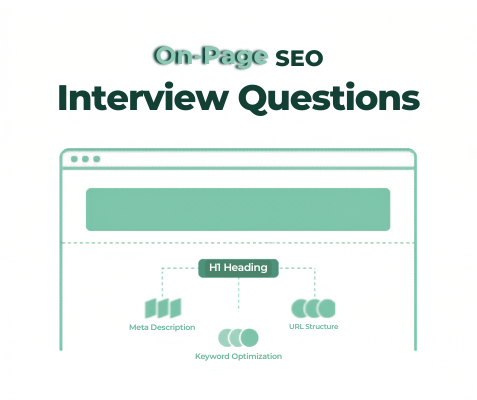
On-page SEO refers to all optimizations done directly on a webpage. Key factors: 1) Title tag with the primary keyword. 2) Meta description that encourages clicks. 3) Header tags (H1, H2, H3) for structure. 4) URL structure — short, clean, keyword-rich. 5) Internal linking to pass link equity between pages.
Q7. What is keyword density and is it still relevant?
Keyword density is the percentage of times a keyword appears in a piece of content relative to the total word count. The old-school rule was 2–3%. Today, Google is smarter — it uses NLP and semantic understanding. Focus on natural usage, LSI keywords (related terms), and covering the topic comprehensively. Keyword stuffing will hurt your rankings.
Q8. What is the ideal length for a meta title and meta description?
Meta title: 50–60 characters (Google truncates beyond ~600px width). Meta description: 150–160 characters. Both should include the primary keyword and be written to entice clicks — your meta description is your ad copy in the organic world.
Q9. What is a canonical tag and when would you use it?
A canonical tag (rel="canonical") tells search engines which version of a URL is the "master" copy. Use it when you have duplicate or similar content across multiple URLs — for example, product pages with filter parameters like ?color=red. Without canonicals, you risk splitting your ranking power across duplicate pages.
Technical SEO Interview Questions
Q10. What is a sitemap and why does it matter?
A sitemap is an XML file that lists all important URLs on your site and tells search engines how to crawl them efficiently. It's especially critical for large sites or new sites with few backlinks. Submit your sitemap via Google Search Console to speed up indexing.
Q11. What is robots.txt?
Robots.txt is a plain text file in your site's root directory that instructs search engine bots which pages to crawl or avoid. Example: Disallowing /admin/ pages prevents them from being indexed. Important: robots.txt controls crawling, not indexing — use noindex meta tags to prevent pages from appearing in search results.
Q12. What is Core Web Vitals and why should an SEO analyst care?
Core Web Vitals are Google's page experience signals: LCP (Largest Contentful Paint — loading speed), FID/INP (Interaction responsiveness), and CLS (Cumulative Layout Shift — visual stability). Since 2021, they are a confirmed Google ranking factor. A slow, janky page will lose rankings to a fast, smooth competitor — even with equal content quality.
Q13. What is structured data / schema markup?
Schema markup is code (usually JSON-LD) added to a page to help search engines understand its content. It can unlock rich results — star ratings, FAQs, recipes, events — in the SERP. Example: Adding Product schema to an ecommerce page can show price and availability directly in search results, increasing click-through rates significantly.
Q14. What is crawl budget?
Crawl budget is the number of pages Googlebot will crawl on your site within a given time frame. For small sites, it's rarely a concern. For large ecommerce or news sites with thousands of URLs, managing crawl budget — by blocking low-value pages via robots.txt or canonicals — ensures your important pages get crawled and indexed faster.
Off-Page SEO Interview Questions
Q15. What is a backlink and why is it important?
A backlink is a hyperlink from one website pointing to yours. Google treats backlinks as votes of confidence — the more high-quality backlinks you have, the more authority your site earns. Real example: If Forbes links to your blog post, Google sees that as a strong signal your content is trustworthy and worth ranking.
Q16. What is the difference between do-follow and no-follow links?
A do-follow link passes "link juice" (PageRank authority) to the linked page. A no-follow link (marked with rel="nofollow") signals to Google not to pass authority. Paid links, user-generated content, and sponsored posts should always be tagged no-follow. A healthy backlink profile contains a natural mix of both.
Q17. What is domain authority (DA)?
Domain Authority is a metric created by Moz (scored 1–100) that predicts how likely a website is to rank in search engines. It's based on the number and quality of inbound links. Note: DA is a third-party metric — Google does not use it officially. However, it's a useful benchmark for comparing your site's link strength against competitors.
Q18. Name three white-hat link building strategies.
1) Guest posting — writing high-quality articles for reputable sites in your niche. 2) Broken link building — finding dead links on other sites and suggesting your content as a replacement. 3) Digital PR / HARO — getting quoted as an expert in media articles, earning authoritative editorial backlinks.
Local SEO Interview Questions
Q19. What is Local SEO and who needs it?
Local SEO is the practice of optimizing a business's online presence to attract more customers from relevant local searches — like "dentist near me" or "best biryani in Delhi." Any business with a physical location or serving a specific geographic area — restaurants, clinics, salons, real estate agents — needs local SEO.
Q20. What is a Google Business Profile (GBP) and how does it help SEO?
Google Business Profile (formerly Google My Business) is a free tool that lets you manage how your business appears on Google Search and Maps. A fully optimized GBP — with accurate NAP (Name, Address, Phone), photos, categories, and reviews — is the single most important factor for ranking in the local "map pack."
Q21. What is NAP consistency and why does it matter?
NAP stands for Name, Address, and Phone number. Google cross-references your NAP across directories, your website, and your GBP. Inconsistent NAP information — different spellings, old phone numbers — confuses search engines and can tank your local rankings. Always audit your citations for accuracy.
Ecommerce SEO Interview Questions
Q22. What are the biggest SEO challenges for ecommerce sites?
Duplicate content from product variants and filters, thin content on category pages, crawl budget waste from faceted navigation, and slow page speeds due to large product images. Solving these — with canonicals, unique descriptions, and image compression — is what separates a good ecommerce SEO specialist from a great one.
Q23. How do you optimize product pages for SEO?
Use unique, keyword-rich product titles and descriptions (not copied from the manufacturer). Add Product schema for rich results. Optimize image alt text with descriptive keywords. Collect and display user reviews (adds fresh, unique content). Improve page load speed — every second of delay costs you conversions and rankings.
Advanced SEO Interview Questions
Q24. What is E-E-A-T and how do you optimize for it?
E-E-A-T stands for Experience, Expertise, Authoritativeness, and Trustworthiness — Google's quality rater guidelines framework. Optimize by: adding author bios with credentials, citing credible sources, earning editorial backlinks, maintaining an updated "About" page, and getting genuine reviews. E-E-A-T is especially critical for YMYL (Your Money or Your Life) topics like health and finance.
Q25. What is the difference between crawling and indexing?
Crawling is when Googlebot discovers and visits your pages by following links. Indexing is when Google analyzes a crawled page and decides to store it in its database to serve as a search result. A page can be crawled but not indexed (e.g., if it has a noindex tag or thin content). Use Google Search Console's URL Inspection tool to check indexing status.
Q26. What is a redirect? When would you use a 301 vs 302?
A 301 (permanent redirect) tells search engines the page has moved forever — it passes the majority of link equity to the new URL. Use it when permanently changing URLs or merging pages. A 302 (temporary redirect) signals a short-term move — search engines keep the original URL indexed. Using a 302 when you mean a 301 is one of the most common and costly SEO mistakes.
Q27. What tools do you use for SEO and why?
Google Search Console — track impressions, clicks, indexing issues, and Core Web Vitals. Google Analytics 4 — understand user behavior and traffic sources. Ahrefs / SEMrush — keyword research, competitor analysis, backlink audits. Screaming Frog — technical site crawls. PageSpeed Insights — performance diagnostics. Knowing why you use a tool is just as important as knowing how.
Q28. How do you measure SEO success?
KPIs include: organic traffic growth, keyword ranking improvements, click-through rate (CTR), domain authority, number of indexed pages, bounce rate, conversion rate from organic traffic, and backlink growth. Always align your metrics with business goals — if the goal is leads, track organic-to-lead conversion, not just rankings.
Q29. What is a featured snippet and how do you optimize for one?
A featured snippet is the box that appears at position zero — above all organic results — displaying a direct answer to a query. To target one: identify question-based keywords your page ranks for on page one, structure your answer clearly in 40–60 words, use H2/H3 tags for the question, and include a concise paragraph answer immediately below.
Q30. What is the impact of AI (like Google's SGE / AI Overviews) on SEO?
Google's AI Overviews (formerly SGE) generate AI-written summaries at the top of SERPs, which can reduce clicks for informational queries. The counter-strategy: focus on bottom-of-funnel, transactional, and highly specific long-tail keywords; build genuine brand authority so you're cited in AI summaries; and invest in E-E-A-T so Google trusts your content as a source.
FAQs
What is the most common SEO interview question for freshers?
The most common question is "What is SEO and how does it work?" Freshers should also be ready to explain the difference between on-page and off-page SEO, what a keyword is, and basic concepts like meta tags and backlinks.
How do I prepare for an SEO executive interview?
Practice explaining your past SEO campaigns with real numbers — traffic growth, ranking improvements, backlinks earned. Know your tools well (GSC, Ahrefs, SEMrush). Understand Google algorithm updates like Panda, Penguin, Helpful Content, and Core Updates, and what each targeted.
Are SEO interview questions different for an SEO analyst vs SEO specialist?
An SEO analyst interview focuses more on data — how you track, measure, and report performance. An SEO specialist interview goes deeper into strategy, technical audits, link building, and cross-channel thinking. Both require strong fundamentals.
What are the latest SEO interview questions in 2026?
Expect questions on Google AI Overviews, Core Web Vitals, E-E-A-T, content pruning strategies, programmatic SEO, and how to do SEO in a post-cookie world. Knowledge of AI tools like ChatGPT for content ideation is also increasingly relevant.
How long does it take to learn SEO?
With a structured course and consistent practice, you can get job-ready in 3–6 months. Hands-on experience — building your own blog, running an SEO audit, executing a link-building campaign — accelerates learning dramatically.
Conclusion
SEO is not just a skill — it's a career with massive, growing demand. The questions and answers in this guide cover everything from basics to advanced technical SEO, giving you a solid foundation to walk into any interview with confidence.
Remember: interviewers aren't just testing your knowledge — they want to see how you think, how you solve problems, and whether you can connect SEO to real business results. Keep learning, keep experimenting, and always back your answers with data.
If you're looking to go beyond interview prep and build a genuine, job-ready SEO and digital marketing skill set, Brillica Services provides a comprehensive Digital Marketing Course that covers SEO from the ground up — including hands-on projects, live campaign experience, Google certification prep, and placement support. Whether you're a student, a career switcher, or a working professional upskilling for growth, Brillica's curriculum is designed to make you industry-ready — not just interview-ready.
Ready to go from interview prep to career launch? Start your SEO journey with Brillica Services today.