

In today’s digital world, businesses rely heavily on data to understand customer behavior, make decisions, and stay ahead of the competition. This is why Data Analytics and Data Science have become two of the most in-demand fields globally. But many students, freshers, and working professionals get confused about which path to choose.
If you are also wondering “What is Data Analytics?”, “What is Data Science?”, or “Which is better: Data Science or Data Analytics?”, this detailed guide will answer all your questions with clear explanations.
What is Data Analytics?
Data Analytics is the process of collecting, cleaning, organizing, and examining data to find useful insights. A data analyst helps companies understand what is happening right now and what happened in the past.

For example, a data analyst may analyze:
- Which product is selling the most
- Why sales dropped last month
- What customers liked or disliked
- Which marketing campaign performed better
Key Goals of Data Analytics
- Identify patterns
- Solve business problems
- Improve performance
- Support decision-making
Where Data Analytics Is Used
- E-commerce
- Banking
- Healthcare
- Retail
- Travel
- Education
- IT and technology companies
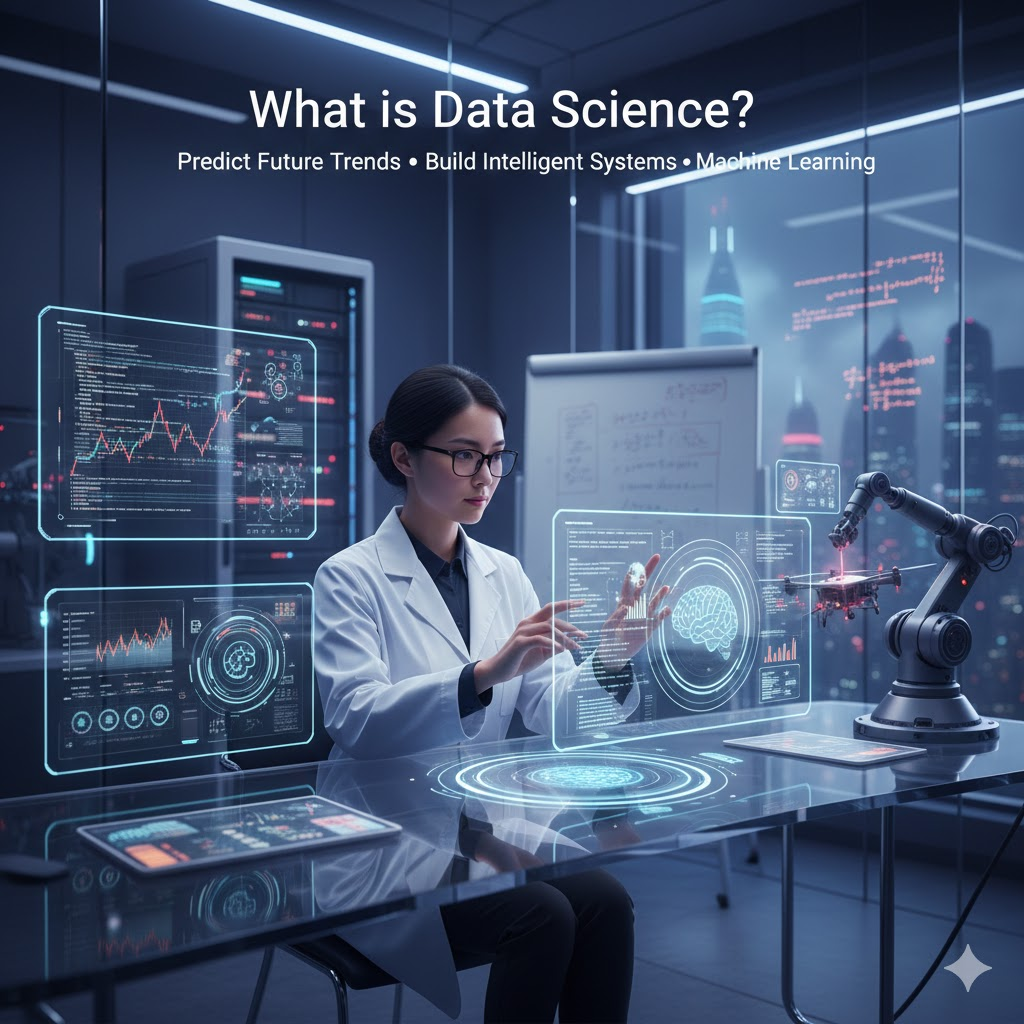
What is Data Science?
Data Science is a more advanced field that uses statistics, programming, and machine learning to predict future trends and build intelligent systems.
A data scientist works deeply with data to answer complex questions, automate tasks, and build predictive models.
What Does a Data Scientist Do?
- Build machine learning models
- Predict customer behavior
- Use artificial intelligence (AI) techniques
- Process and analyze large volumes of data
- Build algorithms and automation pipelines
Where Data Science Is Used
- Self-driving cars
- Fraud detection
- Personalized recommendations (Netflix, Amazon)
- Medical diagnosis
- Chatbots and AI systems
- Finance and stock market prediction
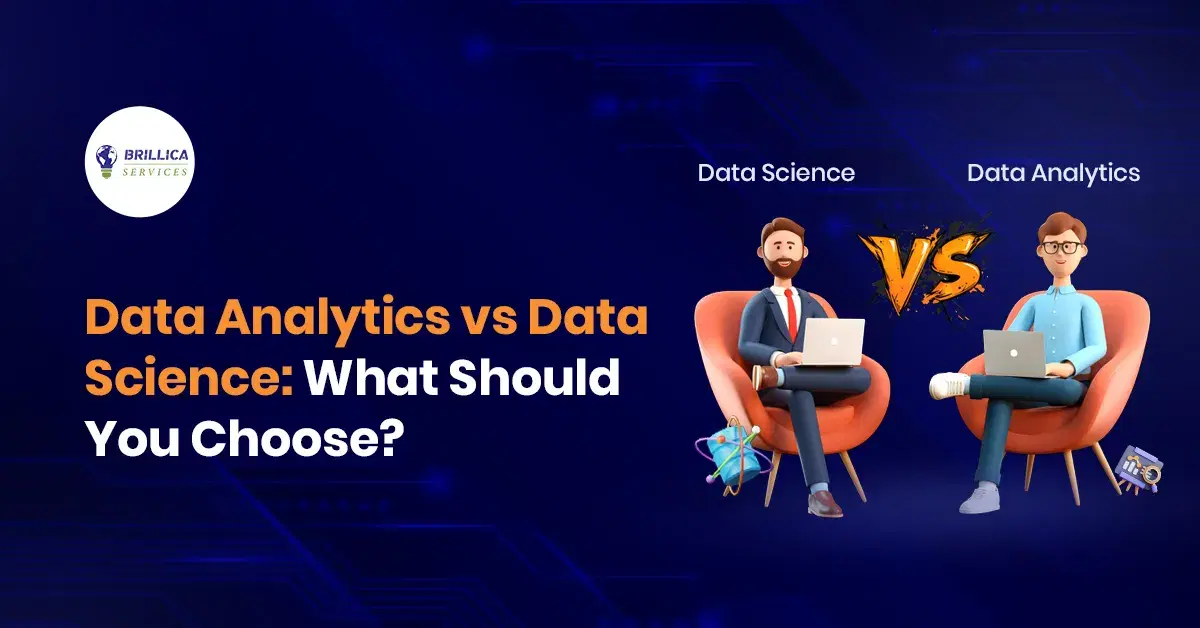
Difference Between Data Analytics and Data Science
Although both fields deal with data, their purpose, tools, skills, and outcomes are different.
Below is the clear comparison:
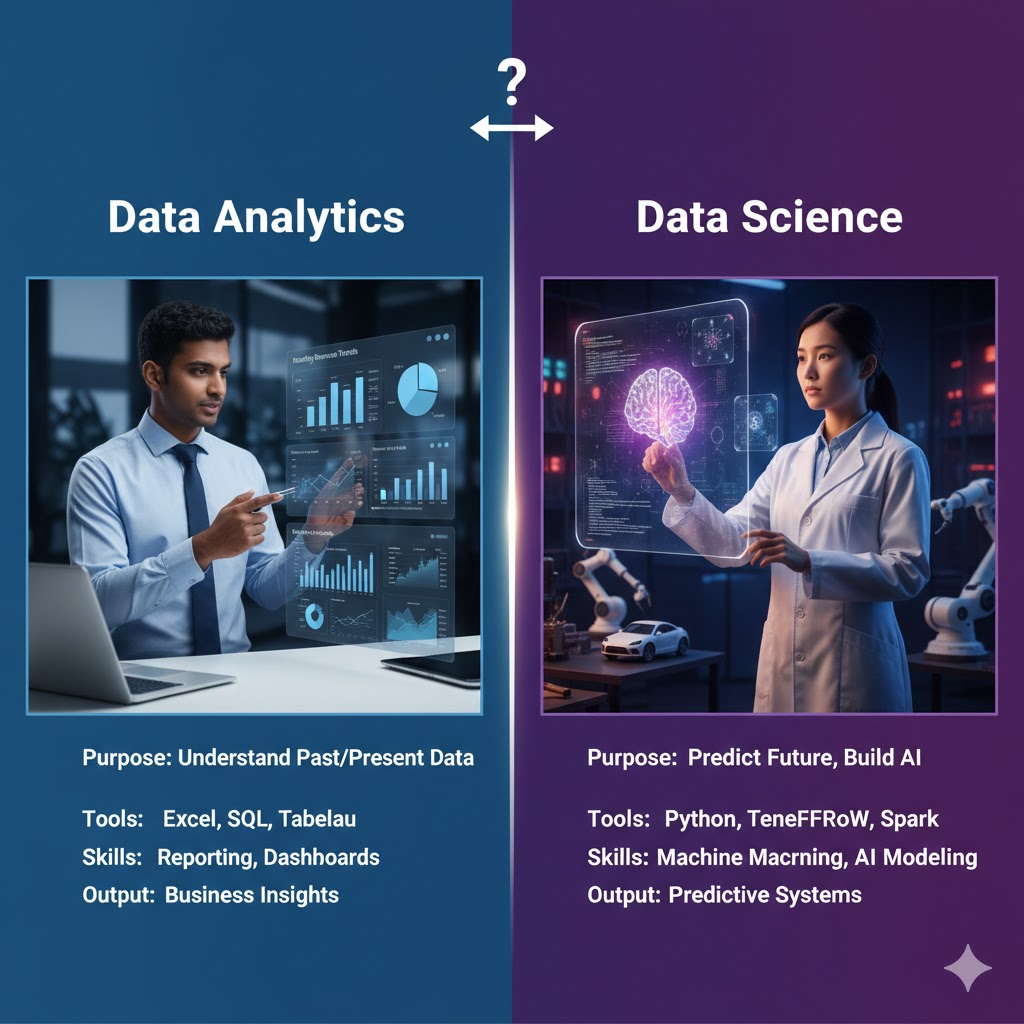
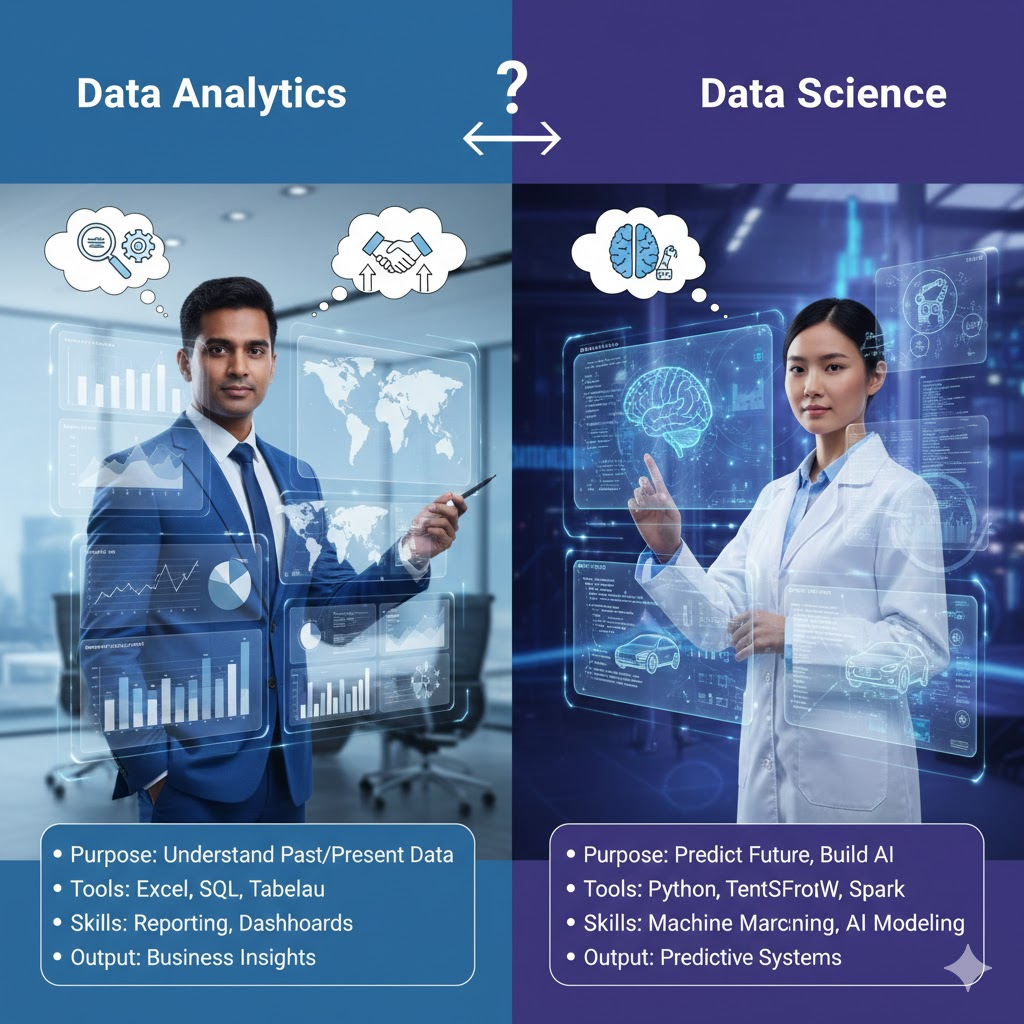
1. Purpose
- Data Analytics: Understand past and current data
- Data Science: Predict the future and build AI-driven solutions
2. Skills Needed
- Data Analyst: Excel, SQL, Power BI, Tableau
- Data Scientist: Python, Machine Learning, Deep Learning, Big Data
3. Tools Used
- Data Analyst Tools: Excel, Power BI, Tableau, SQL
- Data Scientist Tools: Python, R, TensorFlow, Hadoop, Spark
4. Job Role Focus
- Data Analyst: Reporting, dashboards, insights
- Data Scientist: Prediction, modeling, automation
5. Salary
- Data Scientists generally earn more because the work is more complex.
Difference Between Data Analyst and Data Scientist
Data Analyst
- Works on structured data
- Builds dashboards and reports
- Helps companies understand what is happening
Data Scientist
- Works on huge, complex datasets
- Creates ML models and AI solutions
- Predicts future trends
Data Analytics vs Data Science: Which is Better?
Both fields are excellent career options, but the right choice depends on your interest.
Choose Data Analytics if:
- You like working with charts, reports, and dashboards
- You prefer business-focused roles
- You want to start quickly with less technical skills
Choose Data Science if:
- You enjoy coding and mathematics
- You want to work on AI and machine learning
- You want high-paying advanced technical roles
Is Data Science and Data Analytics Same?
No. Both fields are related but not the same.
Data Analytics looks at past data, while Data Science predicts future outcomes.
What Does a Data Analyst Do?
A data analyst works with business teams and helps them:
- Clean and prepare data
- Analyze data
- Build dashboards
- Identify trends
- Improve business performance
Data Analytics Skills
To become a data analyst, you need:
- Excel
- SQL
- Power BI / Tableau
- Data cleaning
- Statistics basics
- Problem-solving
Data Science Skills
To become a data scientist, you need:
- Python
- Machine learning
- Data visualization
- Mathematics
- Big data tools
- Deep learning
Which Role Is More in Demand?
Both roles are highly in demand, but data science demand is increasing faster due to AI and automation.
According to industry trends:
- Companies hire data analysts to make everyday decisions
- Companies hire data scientists to build intelligent AI solutions
Average Salary of Data Scientist in India
The salary depends on experience and location.
Average Salaries:
- Fresher: ₹7–10 LPA
- Mid-level: ₹12–20 LPA
- Senior level: ₹20–40+ LPA
In big cities like Bangalore, salaries are even higher.
Is Data Analyst Still in Demand in 2026?
Yes, absolutely.
Data analytics is one of the fastest-growing fields. By 2026, most companies will require analysts to handle business data, making this career very secure.
Is Data Science Easier than Data Analytics?
No.
Data Science is more complex because it requires coding, mathematics, and machine learning expertise.
Data Analytics is easier for beginners.
Can I Be Both a Data Analyst and a Data Scientist?
Yes, you can.
Many professionals start as data analysts to build strong foundations and later switch to data science.
Data Science and Data Analytics Jobs
You can get the following roles:
Data Analytics Jobs
- Data Analyst
- Business Analyst
- Reporting Analyst
- Marketing Analyst
- Operations Analyst
Data Science Jobs
- Data Scientist
- Machine Learning Engineer
- AI Engineer
- Data Engineer
- Research Scientist
Data Science and Data Analytics Difference
The data science and data analytics difference becomes clearer when you compare their purpose, tools, complexity, salary, and final output. Data Analytics mainly focuses on understanding the past and present, helping businesses see what has already happened and what is happening right now. It uses simple and business-friendly tools like Excel, SQL, and BI tools such as Power BI or Tableau. The complexity level in analytics is generally low to medium, which makes it easier for beginners to start. Data analytics offers a good salary, and the typical output includes reports, dashboards, and trend analysis that support decision-making.
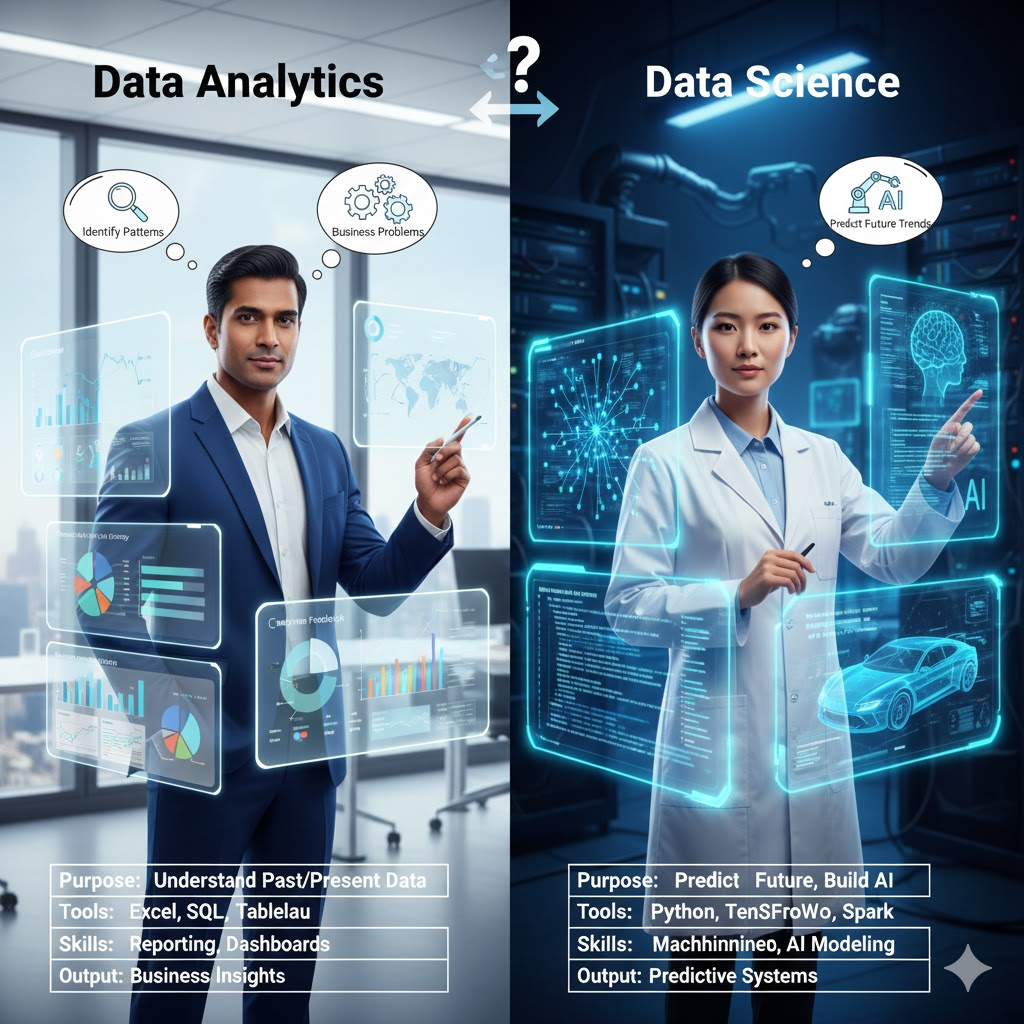
On the other hand, Data Science is more advanced and future-driven. It focuses on predicting future trends, building intelligent systems, and solving complex problems using technologies like Python, Machine Learning, and Artificial Intelligence. The complexity in data science is higher because it involves coding, mathematics, and algorithm building. Due to these advanced skills, data science often offers higher salaries compared to analytics. The output of data science includes predictions, machine learning models, automation systems, and AI-powered solutions, making it ideal for companies aiming for innovation and growth.
Future Scope of Data Analytics and Data Science
Future of Data Analytics
- Business optimization
- Customer insights
- Real-time dashboards
- Automated reporting
Future of Data Science
- AI-driven decision making
- Deep learning advancements
- Robotics & automation
- Large-scale machine learning
Both fields will continue to grow and offer excellent career opportunities.
FAQs
1. Which field has a higher salary: Data Analytics or Data Science?
Data Science usually offers higher salaries due to complex work like machine learning and AI.
2. Can a beginner start with Data Science directly?
Yes, but it’s harder. Most beginners prefer starting with Data Analytics.
3. Is coding required for Data Analytics?
Not much. Basic SQL is enough.
But Data Science requires strong coding skills.
4. What industries hire data analysts and data scientists?
Banking, e-commerce, telecom, healthcare, IT, travel, finance, marketing, and more.
5. Is AI replacing data analysts?
No. AI supports analysts, but human decision-making is still essential.
6. Is Data Science a good career in India?
Yes, it is one of the top 5 highest-paying careers in India.
7. Do companies hire freshers?
Yes, especially if you have practical training, projects, and certifications.
Conclusion
Choosing between Data Analytics vs Data Science depends on your interest, skills, and career goals. If you enjoy business insights, dashboards, and problem-solving, choose Data Analytics. If you want to work with AI, machine learning, and advanced modeling, choose Data Science.
Both fields offer excellent opportunities, high salaries, and long-term growth.
Brillica Services provide Data Analytics Course and Data Science Course for students and professionals who want to build a strong career in these fast-growing fields.