


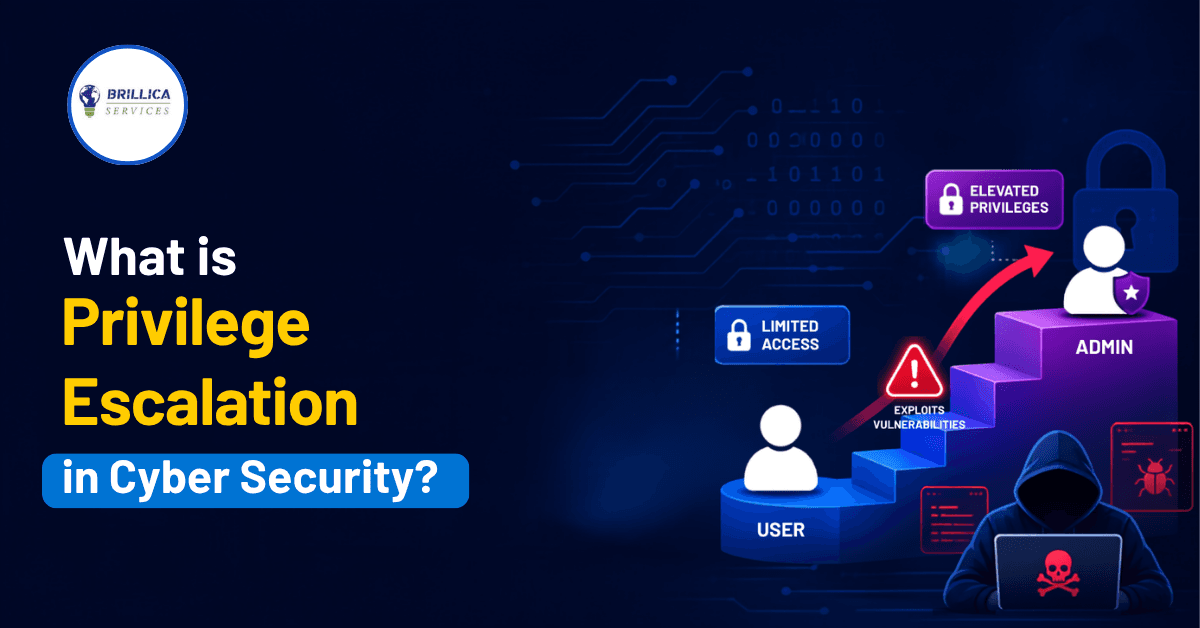
Imagine a normal employee has access to a few files on a company computer. Suddenly, an attacker finds a weakness and gains administrator-level access. Now, the attacker can access files, change settings, install software, or control important parts of the system.
This is where privilege escalation becomes a serious cyber security concern.
But what is privilege escalation, and how does it happen? In simple terms, privilege escalation occurs when a user or attacker gains more permissions than they are supposed to have. It is an important topic in cyber security because attackers often use this weakness to move from limited access to higher-level control.
In this guide, we will explain privilege escalation in cyber security, its types, common techniques, examples, risks, and ways businesses can prevent privilege escalation attacks.
What Is Privilege Escalation?
Privilege escalation is a security issue where a person or program gains access to resources or permissions beyond what was originally allowed.
For example, suppose a user account can only open documents and use basic applications. If that account somehow gains administrator permissions without proper authorization, it becomes a privilege escalation vulnerability.
Attackers look for these weaknesses because higher privileges can give them greater control over a computer, server, application, or network.
Privilege escalation can happen because of software bugs, incorrect permissions, weak security settings, outdated systems, or stolen credentials. It can affect both Windows and Linux environments as well as applications, cloud systems, and business networks.
How Does Privilege Escalation Work?
Understanding how does privilege escalation work starts with understanding user permissions.
Most computer systems have different levels of access. A normal user may have permission to perform everyday tasks, while an administrator or root user has much greater control over the system.
An attacker may first gain limited access through a compromised account, vulnerable application, phishing attack, or another security weakness. Instead of stopping there, the attacker searches for another weakness that could provide higher permissions.
For example, an attacker may discover that a particular application is running with excessive permissions. If that application has a security flaw, the attacker may be able to use it to gain additional access.
The general process is:
Gain initial access.
Identify the current level of permissions.
Look for security weaknesses.
Attempt to gain higher privileges.
Use the additional access to reach protected resources.
This is why privilege management is an important part of cyber security.
Types of Privilege Escalation
There are two main types of privilege escalation: vertical and horizontal privilege escalation.
Vertical Privilege Escalation
Vertical privilege escalation happens when a user moves from a lower level of access to a higher level of access.
For example, a normal user may gain administrator or root-level permissions. This is often the type people think of when they hear about system privilege escalation.
A successful vertical escalation can give an attacker significant control over a system. Depending on the environment, they may be able to modify security settings, access restricted data, or install unauthorized software.
Horizontal Privilege Escalation
Horizontal privilege escalation happens when a user gains access to another account or resource that belongs to a user with a similar level of permissions.
For example, imagine an employee can access their own customer records but discovers a weakness that allows them to access another employee's records. The attacker has not necessarily gained administrator privileges, but they have accessed information that should belong to someone else.
The key difference between horizontal and vertical privilege escalation is the level of access gained. Vertical escalation means moving to a higher privilege level, while horizontal escalation usually means accessing another user's resources at a similar privilege level.
Common Privilege Escalation Techniques
Attackers can use different methods to search for privilege escalation opportunities. These methods depend on the operating system, application, network, and security controls involved.
Some common privilege escalation techniques include:
Exploiting Unpatched Software
Outdated software may contain known security vulnerabilities. If an organization does not apply security updates, attackers may try to exploit these weaknesses to gain additional permissions.
Regular patching is therefore one of the simplest ways to reduce risk.
Misconfigured Permissions
Incorrect file, folder, application, or system permissions can give users more access than they need.
For example, sensitive files may accidentally be accessible to ordinary users. Attackers can look for these configuration mistakes when searching for ways to increase their access.
Weak Credentials
Weak or reused passwords can make accounts easier to compromise. If an attacker obtains credentials for a privileged account, they may be able to move directly to a higher level of access.
Strong passwords, multi-factor authentication, and proper account management can help reduce this risk.
Vulnerable Applications
Applications running with high privileges can create serious security problems if they contain vulnerabilities.
Security teams should regularly review important applications, remove unnecessary software, and make sure critical systems are properly updated.
Excessive User Privileges
Giving employees more permissions than they need increases the possible impact of a compromised account.
A user who only needs access to a few business applications should not automatically receive administrator-level access.
Privilege Escalation Examples
Let's look at some simple privilege escalation examples.
Example 1: Normal User Becomes Administrator
An attacker compromises a standard employee account. The account has limited access, so the attacker looks for a weakness in the operating system. They discover a vulnerability that allows the account to gain administrator permissions.
The attacker has now performed vertical privilege escalation.
Example 2: One User Accesses Another User's Data
A customer uses an online application and should only be able to view their own account information. Due to an authorization problem, the customer can access another customer's information.
This is an example of horizontal privilege escalation because the user is accessing another user's resources at a similar permission level.
Example 3: Misconfigured Business Server
A company server has incorrectly configured permissions. A low-level account can access files or system resources that should only be available to administrators.
An attacker who compromises that account may use the configuration weakness to gain additional control.
These examples show why proper permissions and access controls are important for both small businesses and large organizations.
Privilege Escalation in Ethical Hacking
Privilege escalation in ethical hacking is used to identify security weaknesses before malicious attackers can take advantage of them.
During an authorized security assessment, an ethical hacker may begin with limited access to a system and check whether security controls prevent unauthorized privilege increases.
The purpose is not to damage the system or access information without permission. Instead, the ethical hacker documents the weakness and reports it to the organization so the security team can fix it.
This makes privilege escalation testing an important part of penetration testing and security assessments.
Ethical hackers may examine areas such as user permissions, system configurations, software versions, access controls, and security policies. All testing should be performed only with proper authorization and within an agreed testing scope.
Why Is Privilege Escalation Dangerous?
A privilege escalation attack can increase the impact of an existing security breach.
An attacker with basic access may have limited capabilities. However, if they gain administrator or root-level privileges, they may be able to access sensitive information, change system settings, disable security controls, install unauthorized software, or move further through a network.
For businesses, this can result in:
Data theft
Privacy problems
Service disruption
Financial losses
System damage
Loss of customer trust
Compliance issues
This is why cyber security teams need to treat privilege escalation vulnerabilities seriously.
How to Prevent Privilege Escalation Attacks
Organizations can take several steps for privilege escalation attack prevention.
Follow the Principle of Least Privilege
Users should receive only the permissions they need to complete their work. Avoid giving administrator access unless it is genuinely required.
Keep Systems Updated
Regularly update operating systems, applications, security tools, and other software. Security patches often fix vulnerabilities that attackers may try to exploit.
Use Multi-Factor Authentication
MFA adds another security layer even if a password is stolen. It is especially important for administrator and other high-privilege accounts.
Monitor Privileged Accounts
Organizations should monitor administrator and other privileged accounts for unusual activity. Unexpected changes in permissions or account behavior can be signs of compromise.
Review Permissions Regularly
Employee roles change over time. Someone may no longer need access that was previously granted to them. Regular access reviews can help remove unnecessary permissions.
Conduct Security Testing
Regular vulnerability assessments and authorized penetration testing can help organizations identify weaknesses before attackers find them.
Tips for Students Learning Privilege Escalation
If you are a beginner learning cyber security or ethical hacking, start with the basics instead of trying to learn advanced techniques immediately.
First, understand networking, operating systems, Linux, Windows permissions, authentication, authorization, and basic security concepts. Then learn how security professionals identify vulnerabilities in controlled lab environments.
Practice only on systems you own or platforms where you have clear permission to test. Building a safe lab environment is a much better way to develop practical skills than testing random websites or systems.
Most importantly, focus on understanding why a vulnerability exists and how to fix it, not just how it can be exploited.
FAQ
What is privilege escalation in cyber security?
Privilege escalation in cyber security is a situation where a user, application, or attacker gains permissions beyond the level they were originally given. It can allow access to protected resources or higher-level system controls.
What is a privilege escalation attack?
A privilege escalation attack occurs when an attacker exploits a weakness to obtain higher or unauthorized access within a system or application.
What is the difference between horizontal and vertical privilege escalation?
Vertical privilege escalation involves gaining a higher level of access, such as moving from a normal user to an administrator. Horizontal privilege escalation involves accessing another user's resources without necessarily gaining a higher privilege level.
Is privilege escalation part of ethical hacking?
Yes. Privilege escalation in ethical hacking is commonly tested during authorized security assessments and penetration tests to identify weaknesses in access controls and system configurations.
How can businesses prevent privilege escalation attacks?
Businesses can reduce the risk by following least-privilege access, updating software, using MFA, reviewing permissions, monitoring privileged accounts, and conducting regular security assessments.
Conclusion
Privilege escalation is an important concept for anyone learning cyber security or ethical hacking. It explains how an attacker can move from limited access to greater control by taking advantage of weaknesses such as outdated software, poor permissions, weak credentials, and system misconfigurations.
Understanding how privilege escalation attacks work can help students build strong cyber security skills and help businesses identify security risks before they become serious incidents. For ethical hackers, learning privilege escalation is also an important part of understanding penetration testing and system security.
If you want to build practical skills and start a career in ethical hacking, professional training can give you a stronger foundation. Brillica Services provides the best Ethical Hacking Course in Dehradun, with practical learning designed to help students understand important cyber security concepts and develop job-ready skills.
Start learning ethical hacking, strengthen your technical skills, and take your first step toward a career in cyber security
