


Machine learning is no longer limited to big technology companies. Today, it is used in online shopping, banking, healthcare, education, marketing, social media, and many other industries. But before learning advanced concepts, it is important to understand the types of machine learning and how each one works. In simple terms, machine learning allows computers to learn from data and make predictions or decisions without being programmed for every single task.
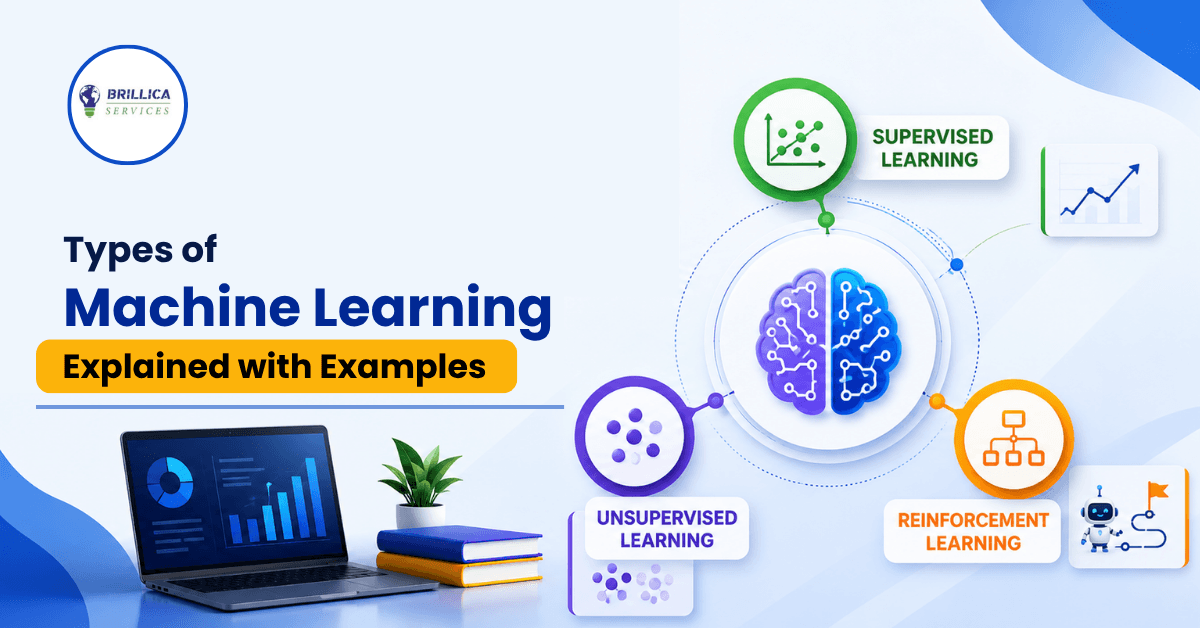
If you are a student, beginner, or business owner planning to learn machine learning, understanding its basic types is a great starting point. In this guide, we will explain the three main machine learning types—Supervised Learning, Unsupervised Learning, and Reinforcement Learning—with simple examples and practical uses.
What Is Machine Learning?
Machine learning is a part of artificial intelligence (AI) that helps computers learn patterns from data and use those patterns to make predictions or decisions. Instead of giving a computer fixed instructions for every situation, we provide data and a suitable learning method so the system can improve its results over time.
For example, an email service can learn to identify spam by studying thousands of emails that have already been marked as spam or not spam. After learning from this data, the system can predict whether a new email is likely to be spam. This is one of the simplest machine learning examples and shows how computers can learn from past information.
Machine Learning Definition in Simple Words
Machine learning is a technology that enables computers to learn from data, identify patterns, and make predictions or decisions without being explicitly programmed for every task.
Introduction to the Types of Machine Learning
There are three main types of machine learning:
Supervised Machine Learning
Unsupervised Machine Learning
Reinforcement Learning
Each type uses data differently and is suitable for different problems. The right approach depends on the type of data available and what you want the machine learning model to achieve.

1. Supervised Machine Learning
Supervised machine learning is one of the most widely used machine learning techniques. In this approach, the model learns from a dataset where the correct answers are already provided. This means the data contains both input and output, allowing the model to understand the relationship between them.
Think of it like teaching a student with a question-and-answer book. You provide examples along with their correct answers. After studying those examples, the student can try to answer new questions. In the same way, a supervised machine learning model studies labeled data and then makes predictions on new, unseen data.
How Supervised Learning Works
The basic process usually involves:
Collecting relevant data
Preparing and cleaning the data
Adding correct labels or outputs
Training the machine learning model
Testing the model with new data
Using the trained model to make predictions
Examples of Supervised Machine Learning
House price prediction: A model can learn from previous house sales using information such as location, size, number of rooms, and age. It can then predict the price of a new house.
Spam email detection: The model learns from emails labeled as "spam" and "not spam" and uses those patterns to classify new emails.
Customer churn prediction: Businesses can use customer information and past behavior to predict which customers may stop using their services.
Common Supervised Learning Algorithms
Some popular algorithms include:
Linear Regression
Logistic Regression
Decision Trees
Random Forest
Support Vector Machines
K-Nearest Neighbors
Neural Networks
Supervised learning is commonly used for classification and regression problems.
2. Unsupervised Machine Learning
In unsupervised machine learning, the model works with data that does not have predefined labels or answers. Instead of telling the model what the correct result should be, we allow it to discover hidden patterns, groups, or relationships within the data.
For example, imagine a retail company has information about thousands of customers but does not know how to divide them into groups. An unsupervised learning model can study customer behavior, purchase history, and spending patterns and create groups of customers with similar characteristics.
How Unsupervised Learning Works
The model receives raw or unlabeled data and looks for patterns within it. Depending on the problem, it may identify similar groups, reduce the number of variables, or discover relationships between different pieces of information.
Examples of Unsupervised Machine Learning
Customer segmentation: An online store can group customers based on their purchasing behavior, spending habits, and interests.
Product recommendation: Businesses can analyze products that customers frequently purchase together and use those patterns to improve recommendations.
Anomaly detection: Companies can use machine learning to identify unusual patterns in transactions or system activity.
Common Unsupervised Learning Algorithms
Popular techniques include:
K-Means Clustering
Hierarchical Clustering
DBSCAN
Principal Component Analysis (PCA)
Association Rule Learning
Unsupervised learning is especially useful when businesses have large amounts of data but do not have predefined categories or labels.
3. Reinforcement Learning
Reinforcement learning works differently from supervised and unsupervised learning. In this approach, an agent learns by interacting with an environment. It takes actions and receives rewards or penalties based on those actions.
The goal is to learn which actions produce better results over time.
A simple real-world example is training a dog. When the dog performs the desired action, it receives a reward. Over time, it learns which behavior is more likely to produce a positive result. Reinforcement learning follows a similar idea, although the actual systems and mathematical methods can be much more complex.
How Reinforcement Learning Works
The main components are:
Agent: The system that makes decisions
Environment: The situation in which the agent operates
Action: What the agent chooses to do
Reward: Feedback received after an action
State: The current situation of the environment
The agent learns through repeated interactions and tries to maximize its total reward.
Examples of Reinforcement Learning
Gaming: Reinforcement learning can train systems to play games by learning which actions lead to better outcomes.
Robotics: Robots can learn how to perform certain tasks by receiving feedback about their actions.
Self-driving technology: Reinforcement learning can be used in research and development to help systems learn decision-making strategies in changing environments.
Resource management: Businesses can use reinforcement learning approaches to optimize certain decisions involving changing conditions and competing objectives.
Supervised vs Unsupervised vs Reinforcement Learning
Understanding the difference between the major machine learning types becomes easier when you compare how they learn.
Type | Data | Main Goal | Example |
|---|---|---|---|
Supervised Learning | Labeled data | Make predictions | Spam detection |
Unsupervised Learning | Unlabeled data | Find patterns | Customer segmentation |
Reinforcement Learning | Feedback from actions | Maximize rewards | Game-playing agent |
The biggest difference is the learning process. Supervised learning learns from known answers, unsupervised learning discovers patterns without predefined answers, while reinforcement learning learns through actions and feedback.
Benefits of Machine Learning
Machine learning can provide several benefits when it is applied to the right business or technical problem.
Automation
Machine learning can automate tasks that require repeated analysis of large amounts of data. This can reduce manual work and help teams focus on more important activities.
Better Predictions
Machine learning models can identify patterns in historical data and use them to make useful predictions, such as sales forecasts, customer behavior, or demand estimates.
Personalized Experiences
Companies can use machine learning to understand customer preferences and provide personalized recommendations, content, or offers.
Finding Hidden Patterns
Unsupervised learning can help organizations discover patterns that may not be obvious through manual analysis.
Popular Machine Learning Tools
If you want to start learning machine learning, several tools and technologies can help you build and test machine learning models.
Python is one of the most popular programming languages for machine learning because it has a large ecosystem of libraries.
Some commonly used machine learning tools and libraries include:
NumPy – numerical calculations
Pandas – data cleaning and analysis
Matplotlib – data visualization
Scikit-learn – traditional machine learning algorithms
TensorFlow – machine learning and deep learning
PyTorch – machine learning and deep learning
Jupyter Notebook – interactive coding and experimentation
Beginners should first focus on Python, basic statistics, data handling, and simple machine learning algorithms instead of trying to learn every tool at once.
Tips for Beginners Learning Machine Learning
If you are starting your machine learning journey, follow a step-by-step approach.
Start with Python: Learn variables, functions, loops, lists, dictionaries, and basic object-oriented programming.
Learn data handling: Understand how to work with datasets using Pandas and NumPy.
Understand basic statistics: Concepts such as mean, median, probability, correlation, and standard deviation can help you understand machine learning better.
Practice with real datasets: Build small projects such as house price prediction, customer segmentation, or spam classification.
Learn model evaluation: Do not focus only on building a model. Learn how to check whether its predictions are reliable using suitable evaluation metrics.
Build projects: Practical projects can help you understand how machine learning works outside theoretical examples.
Frequently Asked Questions About Types of Machine Learning
What are the 3 main types of machine learning?
The three main types are supervised learning, unsupervised learning, and reinforcement learning. They differ mainly in how a model learns from data and feedback.
Which type of machine learning is easiest for beginners?
Supervised learning is often a good starting point because beginners can work with datasets where the expected output is already available. Simple projects such as house price prediction can make the concept easier to understand.
Is Python required for machine learning?
Python is not the only programming language used for machine learning, but it is one of the most popular choices. Its libraries, large community, and simple syntax make it suitable for beginners.
What is the difference between supervised and unsupervised learning?
Supervised learning uses labeled data with known outputs, while unsupervised learning works with unlabeled data and tries to discover patterns or groups within that data.
Where is machine learning used?
Machine learning is used in areas such as recommendation systems, fraud detection, customer analysis, image recognition, search engines, forecasting, healthcare research, finance, and automation.
Conclusion
Understanding the types of machine learning is one of the first steps toward building a strong foundation in artificial intelligence and data science. Supervised learning is useful when you have labeled data and want to make predictions. Unsupervised learning helps discover hidden patterns and groups, while reinforcement learning allows an agent to learn through actions, rewards, and feedback.
If you are a student or beginner, do not try to learn everything at once. Start with Python, data analysis, basic statistics, and simple machine learning models, then gradually move toward advanced machine learning techniques and real-world projects.
If you want structured training to build practical skills, Brillica Services provide the best Machine Learning course in Dehradun, helping learners develop the knowledge needed to work with machine learning concepts, tools, and projects.
Ready to start your machine learning journey? Choose the right course, practice with real datasets, and start building your first machine learning project today.
