


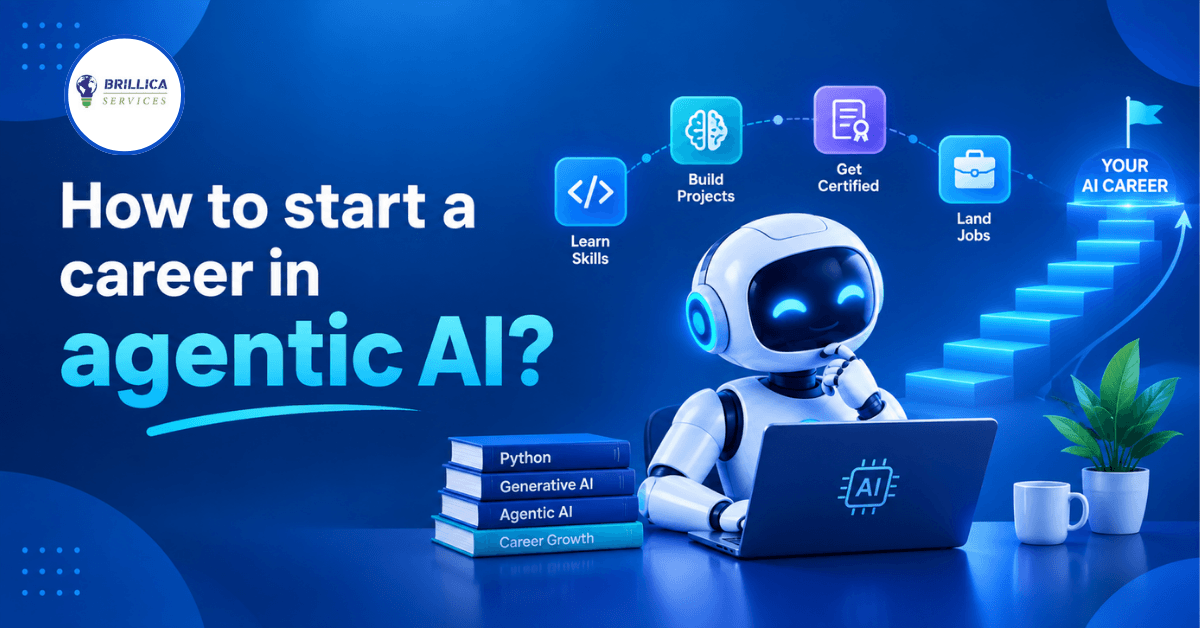
Artificial Intelligence is moving beyond simple chatbots and content generation. Today, AI systems can understand goals, make decisions, use tools, interact with software, and complete multi-step tasks with limited human intervention. This shift is creating a new area of technology known as Agentic AI.
If you are wondering how to start a career in agentic AI, now is a good time to start building the right foundation. Agentic AI combines technologies such as Large Language Models (LLMs), Python, APIs, automation, databases, machine learning, and software development. It is not limited to experienced AI engineers either. Students, freshers, developers, data professionals, and even business owners can begin learning these concepts step by step.
According to OpenAI's practical guide, AI agents can independently accomplish tasks by using an LLM to manage workflows and selecting tools to gather information or take actions. This makes agentic systems different from traditional applications that simply respond to a user's individual prompt.
So, what does an agentic AI career look like, what skills do you need, and how can you become an AI agent developer or engineer? Let's explore the complete roadmap.
What Is Agentic AI?
Agentic AI refers to AI systems designed to work toward a goal rather than simply provide a single response. An AI agent can receive a task, reason about the steps required, use available tools, evaluate results, and continue working until the task is completed or human intervention is required.
For example, imagine asking an AI system to research competitors for your business. A basic generative AI tool might give you a response based on your prompt. An agentic system could potentially break the task into smaller steps, search for information, organize the findings, analyze the data, create a report, and deliver the final result.
This is why agentic AI is becoming an important area of AI development. Modern agent systems can connect LLMs with data sources, APIs, databases, applications, and other tools. OpenAI describes data tools, action tools, and orchestration tools as important categories when building agents.
Why Choose an Agentic AI Career?
The growth of AI agents is creating new possibilities for software development, automation, customer support, research, data analysis, marketing, cybersecurity, and business operations. Instead of using AI only for generating content or answering questions, organizations can use AI systems to handle parts of larger workflows.
This creates opportunities for people who understand both AI and practical software development. An agentic AI professional does not necessarily need to train a foundation model from scratch. In many cases, the work involves connecting existing models with tools, data, business logic, APIs, and reliable workflows.
OpenAI has also described the shift toward agents as a move from short AI interactions toward delegated, longer-running tasks that can involve multiple tool calls and iterations.
For beginners, this means an agentic AI career path can be built progressively. You can start with programming and AI fundamentals and then move toward increasingly complex agent projects.
Agentic AI Career Path: Where Should You Start?
If you are asking how to start an agentic AI career as a fresher, avoid trying to learn every AI technology at once. A structured learning path is much more effective.
Step 1: Learn Python Programming
Python is one of the most useful starting points for an AI career. You do not need to become an advanced software engineer on day one, but you should be comfortable writing and understanding Python programs.
Start with variables, conditions, loops, functions, lists, dictionaries, classes, error handling, file handling, and basic object-oriented programming. Once you are comfortable, learn how to work with packages, virtual environments, APIs, JSON, and asynchronous programming.
These concepts will become useful when you start building AI applications that communicate with external services and tools.
Step 2: Understand AI and Machine Learning Fundamentals
Before jumping directly into AI agents, understand how Artificial Intelligence, Machine Learning, Deep Learning, Generative AI, and Large Language Models are related.
You should know basic concepts such as training data, models, inference, neural networks, embeddings, tokens, context windows, and model evaluation. You do not necessarily need advanced mathematics at the beginning, but understanding the basic concepts will help you make better technical decisions.
This foundation is especially useful if you eventually want to become an agentic AI engineer rather than simply an AI application user.
Step 3: Learn Generative AI and LLMs
Agentic AI is closely connected to Generative AI because many modern agents use LLMs as their reasoning and language-processing component.
Learn how LLMs work at a practical level and explore concepts such as prompting, structured outputs, embeddings, function calling, tool use, retrieval-augmented generation (RAG), context management, and model evaluation.
You should also learn how to work with APIs provided by different AI platforms. The goal is not to memorize one platform. Instead, understand the general architecture of an LLM-powered application.
Step 4: Learn APIs, Tools, and Automation
One of the most important agentic AI developer skills is knowing how AI connects with external systems.
Learn REST APIs, JSON, authentication, webhooks, databases, and basic automation. Build small applications that allow an AI model to call a function or retrieve information from another service.
For example, you could build an agent that reads information from a database, searches documents, calculates a result, or sends information to another application.
This is where Agentic AI starts becoming more practical than simply experimenting with prompts.
Step 5: Understand AI Agent Frameworks
Once you understand the fundamentals, explore frameworks and libraries used for building agentic applications. Depending on the project, developers may work with agent SDKs, orchestration frameworks, retrieval systems, workflow tools, and cloud AI platforms.
Do not focus only on learning framework syntax. Frameworks change quickly, so understanding why an agent needs tools, memory, orchestration, evaluation, and guardrails is more valuable than memorizing a particular library.
Your goal should be to understand the architecture behind an AI agent.
Step 6: Learn RAG, Memory, and Knowledge Systems
Many useful AI agents need access to information that is not contained in the model's original training data.
This is where Retrieval-Augmented Generation, vector databases, embeddings, document processing, and search systems become important. You should learn how an agent can retrieve relevant information before generating an answer or taking an action.
Memory is another important concept. Depending on the application, an agent may need to maintain information about a conversation, user preferences, previous actions, or an ongoing task.
Understanding these concepts can significantly strengthen your agentic AI engineer skills.
Step 7: Learn Agent Evaluation and Security
Building an agent that works once is not enough for a professional application. You also need to understand reliability, testing, monitoring, security, and human oversight.
Agents can make incorrect decisions, use the wrong tool, misunderstand instructions, or produce unexpected outputs. Developers therefore need to create clear boundaries around what an agent can access and what actions it can perform.
Learn about authentication, authorization, prompt injection risks, data privacy, logging, evaluation, rate limits, error handling, and human-in-the-loop workflows.
These areas are often overlooked by beginners but are extremely important when AI agents are used in real business environments.
What Skills Are Required for an Agentic AI Engineer?
If you are searching for what skills are required for an agentic AI engineer, think of the role as a combination of AI knowledge and software engineering.
Important agentic AI skills include:
Python programming
AI and machine learning fundamentals
Generative AI and LLM concepts
Prompt engineering
API integration
Function and tool calling
RAG and embeddings
Vector databases
SQL and database fundamentals
Cloud computing basics
AI agent frameworks
Workflow orchestration
Evaluation and monitoring
Security and responsible AI
Problem-solving
Communication and documentation
You do not need to master all these skills simultaneously. Start with Python and AI fundamentals, then gradually add APIs, LLMs, RAG, agent frameworks, and deployment.
Agentic AI Career Roadmap for Beginners
A simple agentic AI roadmap can look like this:
Phase 1 — Programming Foundation
Learn Python, Git, APIs, JSON, SQL, and basic software development.
Phase 2 — AI Foundation
Understand Machine Learning, Deep Learning, NLP, Generative AI, and LLM fundamentals.
Phase 3 — LLM Application Development
Learn prompting, structured outputs, embeddings, RAG, function calling, and model APIs.
Phase 4 — Agent Development
Build agents that can use tools, access information, make decisions, and complete multi-step workflows.
Phase 5 — Production Skills
Learn deployment, cloud platforms, monitoring, evaluation, security, and performance optimization.
Phase 6 — Portfolio and Career Preparation
Build projects, publish them on GitHub, document your work, create a strong resume, and practice technical interviews.
This approach gives beginners a practical agentic AI learning path without making the learning process unnecessarily complicated.
Projects to Build for an Agentic AI Portfolio
One of the best ways to demonstrate your skills is through projects. A certificate can show that you completed training, but a working project can demonstrate how you apply what you learned.
Start with small projects and gradually increase their complexity.
AI Research Agent
Build an agent that can collect information from approved sources, organize findings, summarize them, and create a structured research report.
Customer Support Agent
Create an agent that retrieves information from a knowledge base and responds to customer questions. Add human escalation for questions that require manual support.
Data Analysis Agent
Build an agent that accepts a dataset, analyzes it using Python, identifies patterns, and generates a basic report or visualization.
Resume Screening Assistant
Create a system that compares resumes against defined job requirements and organizes candidates according to specified criteria. Include human review rather than treating the AI output as an automatic hiring decision.
Marketing Workflow Agent
Build an agent that can assist with tasks such as keyword research, content planning, competitor research, and campaign reporting while keeping important decisions under human supervision.
Projects like these can help you demonstrate AI agent developer skills to recruiters and potential clients.
How to Become an Agentic AI Developer in 2026
If your goal is how to become an agentic AI developer in 2026, focus on practical application development rather than only theoretical knowledge.
Start by becoming comfortable with Python and APIs. Then learn LLM application development, RAG, tool calling, agent workflows, databases, and deployment. As you progress, explore different AI models and agent frameworks instead of depending entirely on one tool.
Most importantly, build projects while learning. For every major concept you study, try to create something with it. This makes it easier to understand how different technologies work together.
The AI ecosystem is changing quickly, so continuous learning will remain an important part of an AI agent developer career.
Agentic AI Jobs for Freshers
Students and freshers often ask whether there are agentic AI jobs for freshers. Job titles may vary because organizations do not always use "Agentic AI Engineer" as the exact title.
Depending on your skills, you may encounter roles such as:
AI Engineer
Generative AI Developer
AI Application Developer
Machine Learning Engineer
LLM Application Developer
AI Automation Developer
AI Solutions Developer
Python Developer with AI skills
AI Agent Developer
AI Engineer Intern
The requirements will vary from company to company. Some positions may emphasize software development, while others may focus more heavily on machine learning, LLMs, data engineering, or automation.
This is why developing a broad foundation is useful when preparing for agentic AI job opportunities.
Should You Take an Agentic AI Course or Certification?
Self-learning is possible, but structured agentic AI training can make the learning process easier for beginners. A good course should not focus only on theory. Look for practical projects, mentor support, modern AI tools, programming, APIs, LLMs, agent workflows, evaluation, and portfolio development.
An agentic AI certification course can also be useful as evidence of structured learning. However, certification should support your practical skills rather than replace them. When applying for jobs, your projects, technical understanding, problem-solving ability, and communication skills are also important.
If you are a beginner, choose an agentic AI course for career growth that matches your current level and provides a clear learning path rather than overwhelming you with advanced concepts from day one.
Career Opportunities in Agentic AI
The potential agentic AI career opportunities extend beyond traditional AI companies. Businesses in finance, healthcare, education, e-commerce, marketing, software, customer service, cybersecurity, and other industries can use AI-powered workflows.
For example, an organization might use agents to assist with internal research, document processing, customer support, software development, data analysis, reporting, or repetitive business workflows.
This creates opportunities for people who can understand both the technology and the business problem. A strong professional does not simply build an AI agent because the technology is available. They understand the task, identify where AI can add value, define appropriate boundaries, test the system, and measure whether it actually improves the workflow.
Tips to Build a Successful Agentic AI Career
Start with fundamentals. Do not skip Python, APIs, databases, and basic AI concepts simply because agent frameworks appear exciting.
Build while learning. Create small projects after each major topic instead of waiting until you finish an entire course.
Keep your GitHub active. Upload useful projects with clear README files explaining the problem, technology, architecture, and results.
Follow official documentation. AI tools and frameworks change rapidly. Official documentation is usually a better starting point than relying entirely on old tutorials.
Learn business use cases. Understanding how companies actually use AI will help you build more useful solutions.
Practice explaining your projects. During interviews, you should be able to explain why you selected a particular model, tool, workflow, database, or architecture.
Keep learning. Agentic AI is evolving quickly. Treat your first course or project as the beginning of your learning journey rather than the end.
Conclusion: Start Building Your Agentic AI Career
If you have been searching for how to start a career in agentic AI, the answer is not to learn everything at once. Start with Python and AI fundamentals, move into Generative AI and LLMs, learn APIs and RAG, understand agent workflows, build practical projects, and gradually learn production skills such as evaluation, security, and deployment.
Whether you are a student, fresher, developer, data professional, or business owner, an agentic AI career can begin with a single practical project. The most valuable combination is strong fundamentals, hands-on experience, continuous learning, and the ability to solve real problems with AI.
If you want structured guidance, Brillica Services provides Agentic AI course and AI-focused training designed to help learners develop practical, career-ready skills. Brillica's current programs emphasize practical learning, real-world projects, expert guidance, certification, and career support across AI and related technology areas.
